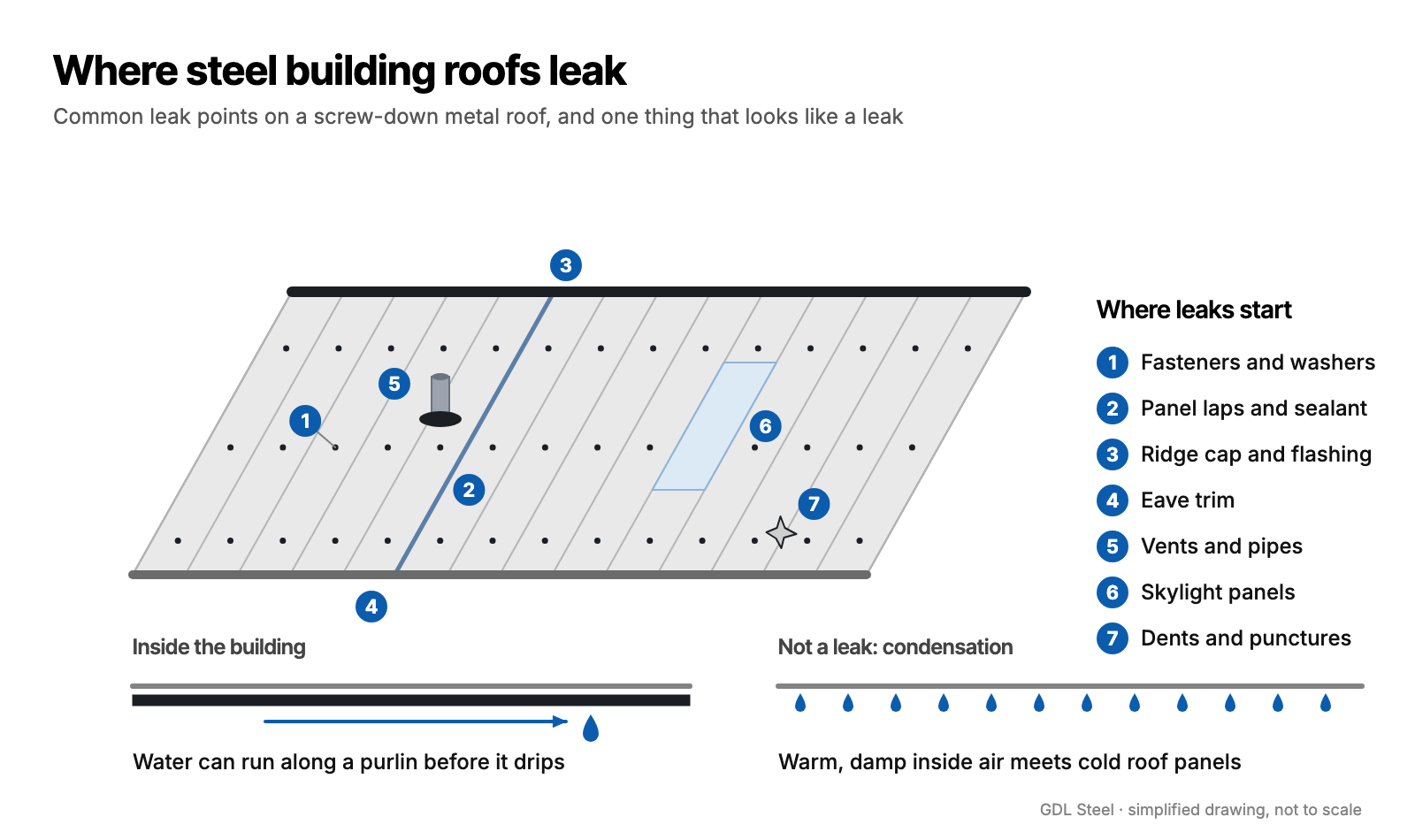
Most leaks in a steel building roof start in a handful of places: the fasteners and their sealing washers, the laps where panels overlap, the trim and flashing at the ridge and eaves, the openings for vents and pipes, skylight panels, and panels that have been damaged. Metal building roof leak repair starts with finding which of those is letting water in, because the water that shows up inside is often some distance from where it got through.
Not every drip is a leak, either. Condensation forms on the underside of cold roof panels and can look exactly like one. This guide covers where leaks start, how to tell them from condensation, how leaks are usually traced and the general ways they are fixed, from a single fastener to a whole roof.
Where a steel building roof leak usually starts
A steel building roof is a set of panels fastened to purlins, the light steel members that run across the main frames. Every joint, fastener and opening in that surface is a place water can find its way in.
- Fasteners and washers. On a screw-down roof, each screw passes through the panel and is sealed by a rubber washer. Washers dry out and crack with age, and screws can loosen as the panels expand and contract through hot days and cold nights. A metal roof leaking at screws is a common complaint with this kind of roof.
- Panel laps and sealant. Where one panel overlaps the next, along its side or at its end, sealant keeps water out of the joint. When that sealant ages or the lap loosens, water can be pulled into the seam.
- Trim and flashing. The ridge cap, eave trim, rake trim and flashing where the roof meets a wall all cover joints. Wind can lift them, and fasteners along them can work loose.
- Penetrations. Vent pipes, exhaust fans and other equipment pass through the roof inside flashings or boots, which crack, shrink or pull away from the panel over time.
- Skylight panels. Translucent panels are made to match the roof panel’s ribs, but they age differently from steel and can turn brittle and crack.
- Damaged panels. Hail, wind, falling ice and foot traffic can dent, crease or puncture panels, and rust tends to start at laps and cut edges. University of Minnesota Extension also warns that hard scraping or chipping at ice on a roof can damage it and lead to leaks.
Condensation vs roof leak: reading the drips
Condensation forms when warm, damp air inside a building meets the cold underside of the roof panels. It can soak insulation and drip steadily, and it happens without any rain at all.
The pattern usually tells you which one you have:
- Drips on cold mornings, on clear days or across a wide area of the roof point to condensation.
- Drips that start during or after rain or snowmelt, in one spot, near a lap, trim edge or penetration, point to a leak.
- Frost or beads of water across the underside of bare panels, or on the facing of the insulation, point to condensation.
Missing, torn or wet insulation makes condensation worse, and a leak can wet insulation too, so it’s common to find both. Our page on steel shops and garages touches on insulating a steel building for this reason.
Finding the source before fixing anything
Water rarely drips straight down from a leak. It can run along a purlin, the ribs of a panel or the facing of the insulation before it falls, so the wet spot on the floor is only the end of the trail.
You can gather useful clues without going up:
- Note the date, the weather and roughly how long after the rain or snowmelt the drips began.
- Mark where the drips land on a simple sketch of the building, and photograph any stains, rust trails or wet insulation.
- From inside, with a flashlight, look for daylight at the ridge and eaves, rust along the purlins and staining around vents and pipes.
- From the ground, look for lifted trim, panels out of line and damage after hail or wind.
On the roof, the search is usually narrowed by checking the details uphill of the drip, and sometimes by running water over one small area at a time, starting low and working up until the leak shows inside. That work belongs to a crew equipped to work at height. Federal fall protection rules for construction treat skylights as holes that workers must be protected from falling through, and University of Minnesota Extension warns of the danger of falling from a snow-covered or icy roof.
How metal building roof leak repair usually works
Once the source is known, the fix generally matches the detail that failed:
- Fasteners are replaced with new screws and washers, sometimes a slightly larger screw where a hole has worn.
- Laps and seams are cleaned and re-sealed, or re-fastened if they have loosened.
- Trim and flashing are refastened or replaced, and a cracked pipe boot is replaced with a new one.
- Skylight and damaged panels are replaced with panels that match the existing rib profile.
When fasteners and sealant are failing across the whole roof, fixing leaks one at a time can turn into a long chase. Re-fastening and re-sealing the entire roof in one job is the usual alternative. Some roofers also apply coating systems over panels that are still sound. Where panels are rusted through or badly damaged, the choice is replacement, or in some cases a new roof built over the old one on added framing.
Which of these fits depends on the condition of the panels, fasteners and framing. If purlins are bent or the roof line sags, the problem involves the building’s structure as well as its roof. See signs a steel building needs repair and our page on repairs to existing steel buildings.
Screw-down and standing seam roofs
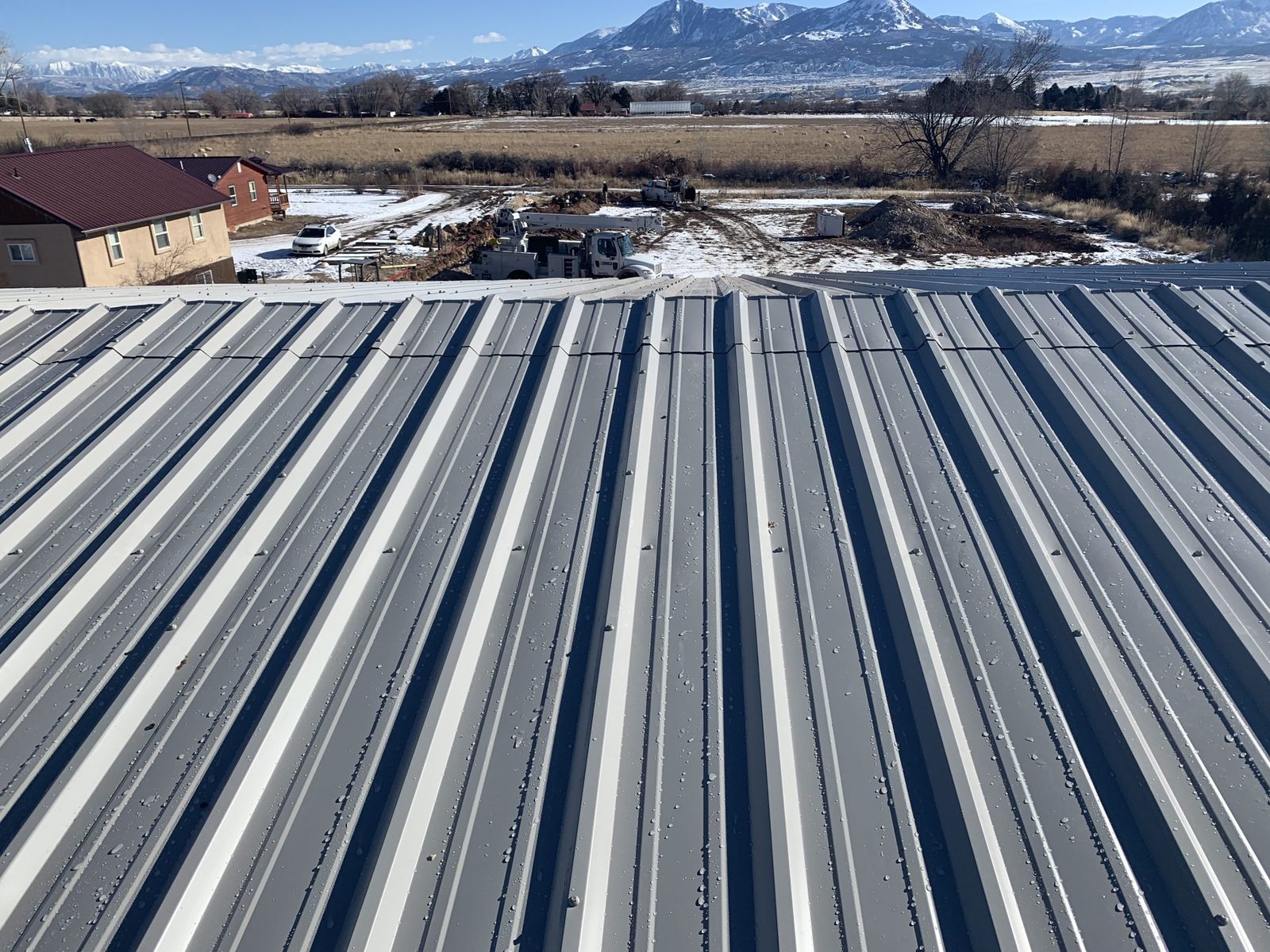
It helps to know which kind of roof you have before anyone goes up. On a screw-down roof, sometimes called exposed-fastener, the screws are visible on top of the panels, so fasteners and washers are the first suspects. On a standing seam roof, the fasteners are hidden under raised seams and held by clips, so leaks tend to come from seams, end laps, trim or penetrations instead.
Storms raise their own questions. Hail can dent panels and crack skylight panels, and a heavy winter can loosen trim and open laps. Our post on what Colorado weather means for a steel building covers hail, snow and wind in more depth, and our roof repairs page is written for owners of existing steel buildings.
A steel building roof leak is much easier to fix once its source is known. Write down when and where the water appears, rule out condensation, stay off the roof, and have the fastener, lap, trim or panel at the source repaired rather than the stain below it.
Common questions
Why is my metal roof leaking at the screws?
On a screw-down roof, every screw is a hole through the panel, sealed only by its rubber washer. Washers dry out and crack with age, and screws can back out as the panels expand and contract, or may have been driven too tight or too loose in the first place. The usual fix is new fasteners and washers where they have failed, or across the whole roof if the problem is widespread.
Is it safe to walk on a steel building roof to look for a leak?
It’s safer to look from the ground and from inside. Skylight panels and weathered panels may not hold a person’s weight, and federal fall protection rules for construction work treat skylights as holes that workers must be protected from falling through. A wet, frosty or snowy steel roof is also slippery, so leave roof access to a crew equipped to work at height.
Can a leaking steel roof be coated instead of replaced?
Sometimes. Coating systems go over panels that are still sound, usually after loose fasteners, open laps and rust have been dealt with. Panels that are rusted through, badly damaged or loose on their framing need repair or replacement first.
Will caulk stop a leak in a steel building roof?
It may slow one for a while, but caulk smeared over a fastener or seam rarely deals with the cause, such as a cracked washer or a loose lap. It can also hide the source from whoever repairs the roof later. Treat it as a stopgap at most.
Trouble with a steel building roof?
GDL Steel handles roof repairs for owners of existing steel buildings in Colorado Springs and along the Front Range. Call (719) 820-5298 or send us a message. More about Roof Repairs.
Keep reading
- Signs a Steel Building Needs Repair After Winter or a Storm
- Hail, Snow and Wind: What Colorado Weather Means for a Steel Building
- From Frame to Finish: How a Pre-Engineered Steel Building Goes Up